
UNMZ and ČAS Conference: The future of cities, the construction industry and infrastructure will be built on data
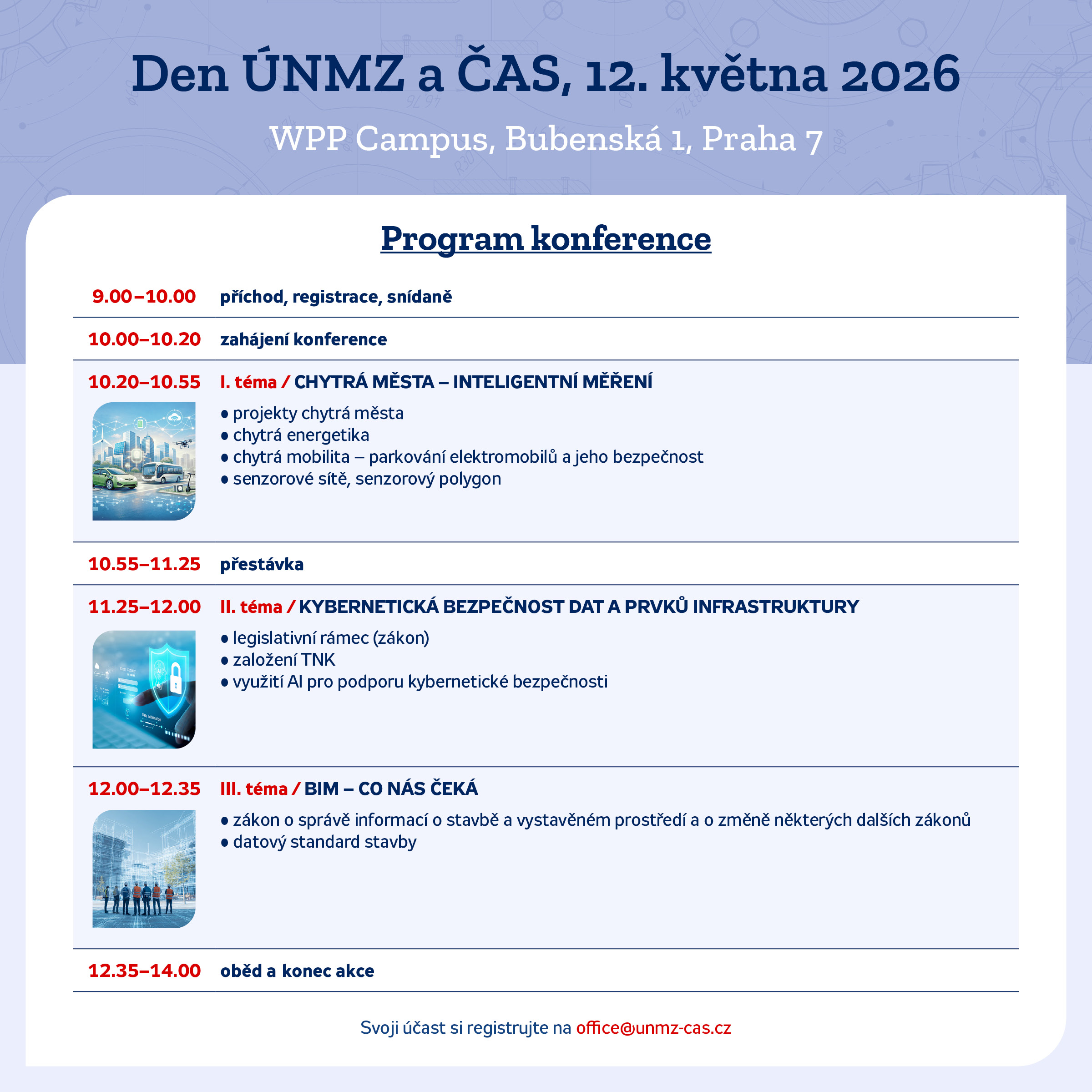
Smart cities, smart metering, cyber security of data and the digitalisation of the construction industry were among the main topics of the ÚNMZ and ČAS Day conference, organised in Prague by the Office for Technical Standardisation, Metrology and State Testing (ÚNMZ) and the Czech Standardisation Agency (ČAS). The expert debate, held across three panel discussions, focused on the integration of modern technologies, data management and infrastructure security in the context of smart cities, as well as BIM methods in the construction industry.
All three panels during the ÚNMZ and ČAS Day were linked by the theme of data. Specifically, they focused on data security and its use in the management of cities, buildings and infrastructure in the Czech Republic. The conference, moderated by Jana Peroutková from Czech Television, also highlighted the growing importance of standardisation for the safe implementation of new technologies in practice. „Standardisation has long since ceased to be merely a matter of industrial standards. Today, it has a significant impact on the functioning of the state, the security of infrastructure and the everyday lives of us all, which is precisely why it is important to open up a debate on technology, security and the digitalisation of society, and on the Czech Republic’s active involvement in the development of European and international technical standards and technical regulations in general,“ he said at the start of the conference Jiří Kratochvíl, Chairman of the ÚNMZ.
Zdeněk Veselý, Chief Executive of ČAS he added: „The role of standardisation is changing significantly. Alongside traditional technical fields, we are now addressing cyber security, BIM, electromobility, artificial intelligence and the circular economy. The aim is to create an environment that will enable the safe introduction of innovations whilst strengthening the Czech Republic’s competitiveness in Europe and globally.“
Smart cities need data, collaboration and a strategy
The first panel, dedicated to smart cities and smart metering, focused on smart energy, smart mobility, the safety of electric vehicles and sensor networks. The panellists agreed that a Smart City is not merely a collection of individual technologies, but an interconnected system based on data, infrastructure and services for citizens.
The panel was attended by Zbyněk Veselák from the National Institute of Metrology (ÚNMZ), Robert Jára from the Czech Technical University (ČVUT), Daniel Miklós from the Fire and Rescue Service of the Czech Republic, Jiří Tesař from the Czech Metrology Institute (ČMI) and Miroslav Scheiner from the Ministry of Industry and Trade (MPO).
Jiří Tesař, Director-General of the Czech Metrology Institute During the debate, he spoke of the growing importance of high-quality, well-structured data for the functioning of smart infrastructure. Participants in the debate also pointed out that Czech towns and cities are currently often implementing smart solutions in a fragmented manner, without broader integration of individual systems. Better coordination between central government, local authorities, academia and the private sector will therefore be essential going forward.
The importance of security in the fields of energy, electromobility and smart infrastructure was also highlighted by Robert Jára, Director of the University Centre for Energy-Efficient Buildings at the Czech Technical University in Prague. According to the panellists, modern cities must be prepared not only for technological development but also for crisis situations and cyber threats.
Cyber security is no longer just an IT issue
The second panel addressed the issue of cyber security relating to data, infrastructure and smart devices. The debate highlighted that cyber security now extends far beyond the field of IT and is becoming a crucial issue for the energy sector, buildings, households and public administration.
The panel on cyber security featured Erika Langerová from CTU’s UCEEB, Zdeňka Slaná from ČAS, Dalibor Kačmář from Microsoft Czech Republic, Aleš Špidla from CEVRO University, Adam Kučínský from the National Cyber and Information Security Agency, and Vít Střítecký from the Faculty of Social Sciences at Charles University (FSV UK). The discussion focused on the legislative framework for cyber security, the establishment of a new technical standardisation committee, and the use of AI in protecting infrastructure and data.
Vít Střítecký from the Department of Security Studies at the Faculty of Social Sciences, Charles University During the debate, he emphasised that cyber security is no longer merely a technical issue, but is increasingly linked to user education, the responsibility of institutions and the functioning of society as a whole. The panellists also highlighted the rapidly growing number of devices connected to the internet and the risks associated with their management and security. Other major topics included residential photovoltaic systems, smart home devices and cloud solutions based outside the EU.
Another key topic of the debate was the role of technical standards and standardisation in the practical implementation of secure digital technologies, a discussion which was opened by Zdeňka Slaná, Director of the Standardisation Department at ČAS: „The fragmentation of rules in cyber security is a weakness that attackers are keen to exploit. Harmonising the requirements for devices will enable us to defend both the entire network and individual users more effectively. Furthermore, if we ensure that practitioners are involved in the development of standards, these standards will not merely be obligations on paper, but a genuine barrier against the threats facing Europe’s digital infrastructure.“ The panellists agreed that harmonising cyber resilience requirements for devices and involving experts more closely in the development of international standards will be crucial for the safer operation of digital infrastructure in Europe.
BIM will transform the way the construction industry operates
The third panel focused on BIM (Building Information Modelling) and the digitalisation of the construction industry. The main topic was the forthcoming legislation and the impending requirement for public contracting authorities to use BIM and the construction data standard from 1 January 2027.
Eva Kaiserová, Kateřina Schön and Štěpánka Tomanová from ČAS, Petr Matyáš from czBIM – buildingSMART CZ, and Filip Žežulka from the Ministry of Industry and Trade (MPO) took part in the debate on BIM and the digitalisation of the construction industry. The main topics were the Act on the Management of Information on Construction and the Built Environment, the construction data standard, and the readiness of public contracting authorities for the mandatory use of BIM from 2027.
Eva Kaiserová, Director of the Project Department at ČAS, explained during the debate that BIM is not merely a 3D model of a building, but above all a system for managing data throughout a building’s entire life cycle – from design through construction to building management. The debate therefore focused more heavily on data management, information sharing and the harmonisation of standards across the construction industry and public administration.
Filip Žežulka, Director of the Department of Construction and Building Materials at the Ministry of Industry and Trade, he pointed out that public contracting authorities have been expected to adopt the BIM method for several years now. In his view, the requirement to use BIM from 2027 onwards should therefore not come as a surprise. According to Žežulka, the key to the further development of BIM will be linking the various aspects of the construction industry’s digitalisation and improving coordination between the state, institutions and the professional community. A greater emphasis on education and practical training for professionals in the field of data handling and digital methods in the construction industry is also expected to contribute to this.